Workplace respiratory surveillanceGeneral guidance — not individual medical advice

Workplace spirometry testing for UK employers.

Lung-function testing and respiratory health-surveillance support for employees exposed to dust, fumes and respiratory sensitisers.

Testing should be selected from your risk assessment and competent occupational-health advice — not booked as a generic health check.

01Risk ledBased on exposure and assessment
02Quality focusedRepeatable, interpretable testing
03ConfidentialClinical detail stays protected
04Programme readyBaseline, review and recall
A test with a defined purpose

Spirometry is one part of respiratory health surveillance.

Occupational spirometry is a breathing test used to measure lung function within a workplace health-surveillance programme. It may help identify change when employees remain exposed to relevant respiratory risks despite controls.

It is not automatically required for every worker, it does not diagnose a condition on its own, and it never replaces exposure prevention. Useful surveillance combines good test technique with symptom information, clinical interpretation, comparison over time and a clear route for further review.

See how a surveillance programme fits together
Exposure navigator

Start with the hazard, not the test.

Select the closest exposure category for general planning prompts. This does not make a legal or clinical determination.

Planning prompt

Review the exposure group and residual risk.

Confirm who is exposed, the substance or process involved, existing controls and whether an identifiable work-related health effect remains reasonably likely.

  • Check the workplace and COSHH risk assessments
  • Group workers by similar exposure
  • Discuss the appropriate surveillance method and frequency
Discuss your workforce General guidance only. Seek competent occupational-health and health-and-safety advice.
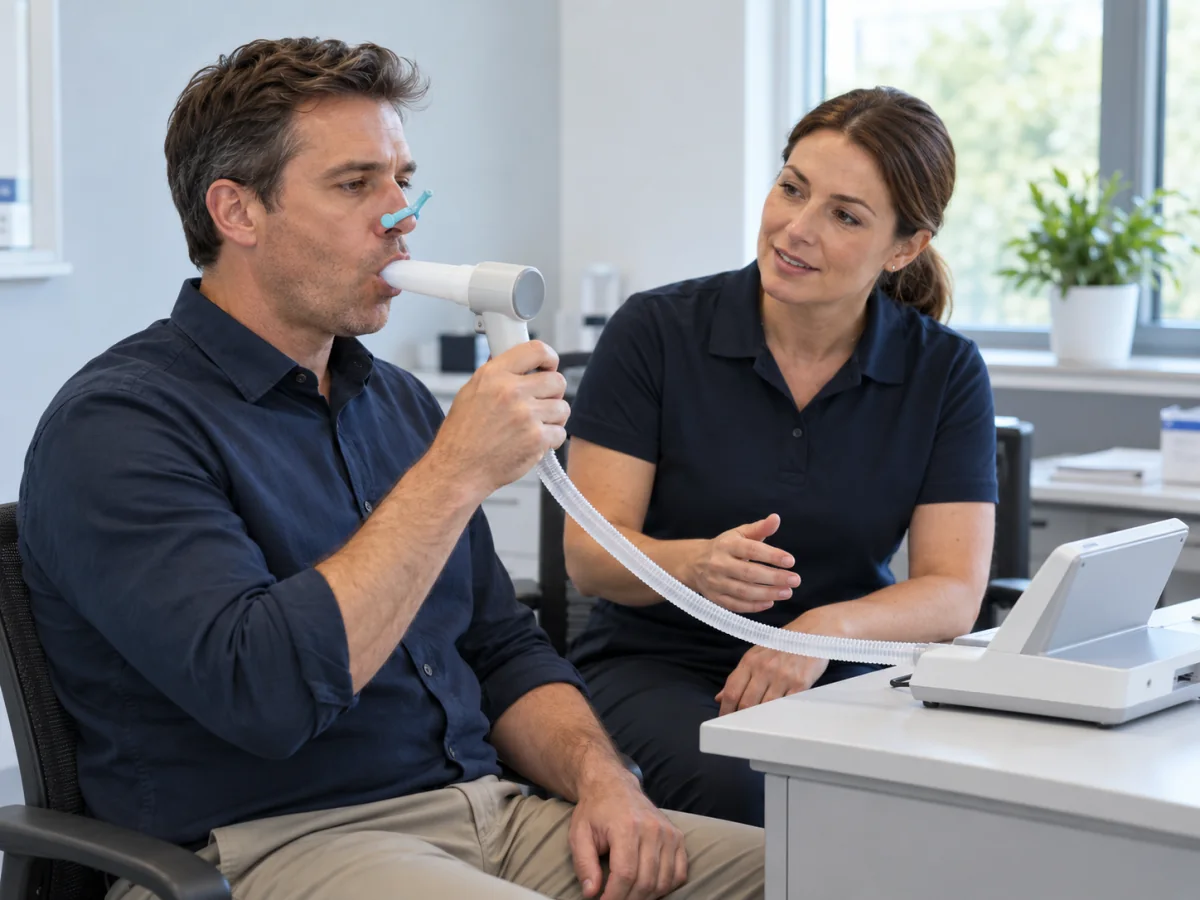
An employee completing a spirometry breathing test while an occupational-health clinician coaches them
What employees can expect: clear coaching and a repeatable breathing manoeuvre.
Why quality matters

A number is only useful when the test behind it is sound.

Reliable surveillance depends on the whole pathway, not simply having a spirometer on site.

01

Preparation

Appropriate pre-test information and safety screening.
02

Technique

Clear coaching and forceful, complete breathing manoeuvres.

03

Repeatability

Enough acceptable attempts to judge consistency.

04

Interpretation

Results considered in context, not treated as a diagnosis.

05

Comparison

Baseline and previous results used where appropriate.

06

Follow-up

Clear escalation when symptoms or changes need review.

Employer pathway

From exposure information to a workable programme.

Programme planning should connect the workforce, exposure groups, locations, shifts and recall dates.

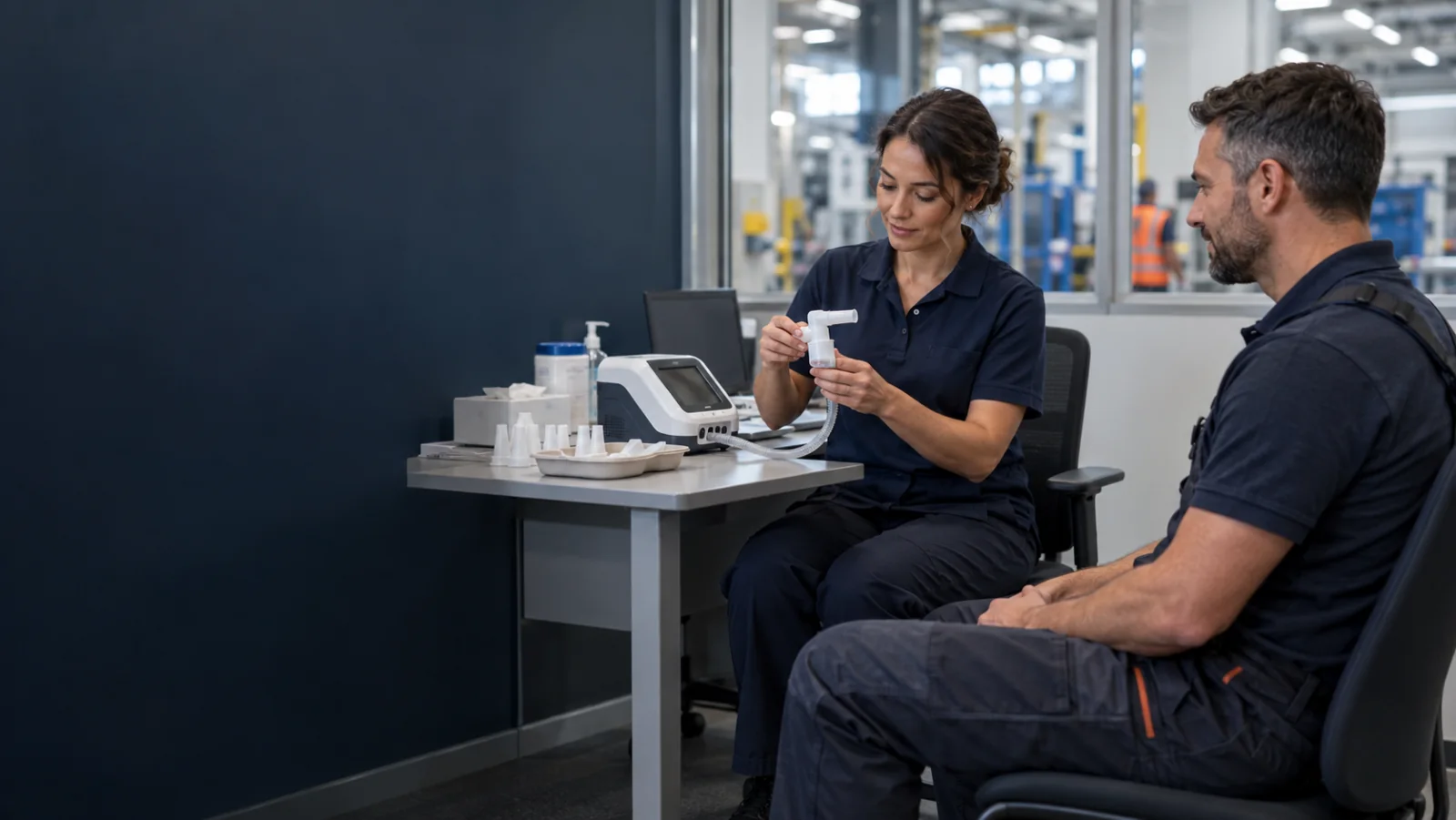
An occupational-health professional and operations manager planning a workplace respiratory health-surveillance programme
Practical planning around exposure groups, sites, shifts and surveillance cycles.
  1. 01

    Enquire

    Share sites, workforce groups and known exposures.

  2. 02

    Review

    Clarify the risk assessment, purpose and delivery needs.

  3. 03

    Plan

    Agree scope, scheduling and employee communications.

  4. 04

    Assess

    Complete questionnaires, safety screening and spirometry.

  5. 05

    Interpret

    Review test quality, results and relevant history.

  6. 06

    Report

    Provide appropriate employer outcomes while protecting clinical detail.

  7. 07

    Act

    Follow recommendations and review exposure controls where needed.

  8. 08

    Recall

    Plan repeat surveillance at a clinically appropriate interval.

Confidential by design

Employers need useful outcomes — not private clinical detail.

HSE distinguishes an employer’s health record from the confidential medical record held by the occupational-health professional.

Employer health record

Work-related outcome

  • Worker and exposure details
  • Surveillance dates
  • Fitness or restrictions relevant to exposure
  • Recall and workplace actions
Confidential medical record

Clinical information

  • Symptoms and health history
  • Detailed test results
  • Clinical notes and reasoning
  • Referral information

Medical records are normally released only with the worker’s written consent.

For employees

Know what to expect before the breathing test.

Wear comfortable clothing and follow the instructions sent with your appointment. You may be asked to avoid a large meal, smoking or alcohol for a period beforehand. Do not stop prescribed medicines or inhalers unless a healthcare professional specifically tells you to.

Read the employee guide
  • 01Bring your medication or inhaler information
  • 02Tell the assessor about recent illness or surgery
  • 03Expect several coached breathing attempts
  • 04Say immediately if you feel unwell or light-headed
Workplace contexts

Exposure patterns vary by task and industry.

Explore industries and exposures
ConstructionManufacturingEngineeringWoodworkingFood productionAutomotiveAgricultureStone workWaste & recycling

These are potential contexts, not a confirmed service-coverage list. The need for surveillance is determined by risk, not industry name alone.

Common questions

Useful answers, with the important caveats intact.

Our regulatory and clinical statements are grounded in HSE and NHS guidance. Business-specific claims remain deliberately unmade until verified.

View all employer and employee FAQs
Is workplace spirometry required for every employee?
No. The need for respiratory health surveillance depends on the risk assessment, workplace exposure, the likelihood of an identifiable work-related health effect and whether a suitable low-risk technique can detect it. Competent occupational-health advice may be needed.
Is one spirometry test a complete surveillance programme?
No. HSE describes health surveillance as an ongoing scheme. A suitable programme may include exposure information, symptom questionnaires, baseline and repeat assessments, clinical interpretation, record keeping and action when concerns arise.
What does spirometry measure?
Spirometry measures how much air a person can forcefully breathe out and how quickly. Common measurements include FVC and FEV1. Results need technically acceptable attempts and appropriate clinical interpretation.
What information does an employer receive?
Employers need an appropriate health record and advice relevant to managing workplace risk. Confidential clinical notes and detailed medical results remain medical records and normally require the worker’s written consent before disclosure.
Does spirometry replace dust or fume controls?
No. Surveillance provides feedback about health risk; it does not replace prevention, exposure control, maintenance, training or respiratory protective measures identified by the risk assessment.
Scope your programme

Tell us about the workforce. We’ll help frame the next conversation.

One site or several, a new baseline or an existing surveillance cycle: share the operational facts without sending employee medical information.

  • Workforce and exposure groups
  • Shift and site requirements
  • One-off or recurring needs
Employer enquiry

Request a tailored quote

Tell us enough to understand the workforce and exposure context. Please do not include employee health information.

About you
Request a tailored quote